Karakuri Placon Selection: Finding the Best Global Suppliers with WJ-LEAN
Dongguan, Guangdong Mar 3, 2026 (Issuewire.com) - In the rapidly evolving landscape of modern manufacturing, the drive toward "Lean Production" and automation has never been more critical. As factories strive to reduce energy consumption and improve ergonomic efficiency, Karakuri systemsdriven by natural gravity and mechanical ingenuity rather than electricityhave emerged as a transformative solution. For procurement professionals and operations managers, navigating the global market to identify the Top 10 Suppliers of Karakuri Placon in the World is a strategic necessity. Selecting the right partner involves more than just comparing product catalogs; it requires finding a supplier that integrates technical precision, global logistics, and a deep understanding of industrial construction.
Q1: Can modular design truly revolutionize your shop floor?
For a purchasing agent, the "Blue Ocean" strategy in manufacturing involves creating a workspace that is both highly productive and incredibly flexible. Implementing a high-end Karakuri Placon system from a verified global supplier allows a facility to transition toward a "Green Factory" model. Since these systems rely on gravity and clever counterweights, they eliminate the need for complex wiring and high electricity costs associated with traditional motorized belts.
Imagine an assembly line where parts flow effortlessly from one station to the next, triggered by the simple placement of a container. This is the "beautiful blueprint" that WJ-LEAN helps its clients draw. Because their systems are modular, a facility can start with a small pilot program and scale up to a fully integrated industrial conveyor network without discarding previous investments. The compatibility of their parts ensures that as a business grows, its infrastructure can grow with it.
Q2: What defines excellence in Karakuri Placon technology?
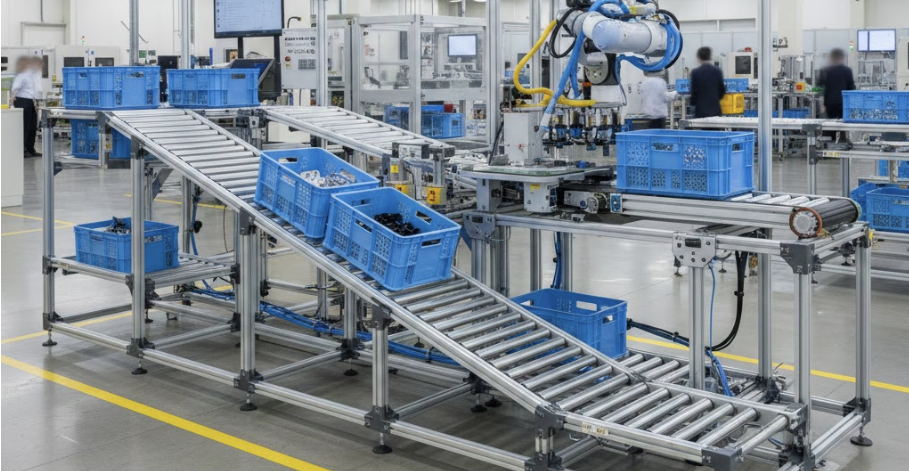
The term "Karakuri" refers to the traditional Japanese art of mechanized puppetry, which in a modern industrial context translates to low-cost automation (LCA). The Placon, or plastic roller conveyor, is the heartbeat of these systems. A high-quality Karakuri Placon system must balance durability with low friction to ensure seamless material handling without external power sources.
Top-tier suppliers distinguish themselves by the modularity of their components. In a dynamic assembly line environment, the ability to rapidly reconfigure frames and conveyor paths is invaluable. This is where technical specifications, such as the precision of nylon wheels and the structural integrity of aluminum or coated pipe frames, become the deciding factors between a system that lasts a decade and one that requires constant maintenance.
Not all roller tracks are created equal. The technical excellence of a Karakuri Placon is measured by its load-bearing capacity, friction coefficient, and durability. Leading suppliers utilize advanced polymers for the rollers and high-grade aluminum or steel for the frames.
More On Toptelecast ::
- The 2026 Powerhouse: Why Shandong Hesper Ranks Among China's Top 10 Industrial Hose Manufacturers
- Congruit Makes Power Move: Wagner Joins Board, Clients Queue Up
- ART - SOUL: Hamptons Celebrates Black Artistry
- Al-Rabiya unveils Vunyx® Shield Pro Plus: Premium paint protection film from Onyx Coating
- Bob David, Recognized by BestAgents.us as a 2026 Top Agent
For instance, WJ-LEAN has gained recognition for its aluminum linear sliding components designed specifically for Karakuri integration. These components are engineered to ensure smooth, consistent movement even under varying loads. The precision in the manufacturing process ensures that the rollers do not "bind," which is a common failure point in cheaper alternatives. Furthermore, the integration of modular pipe and joint systems allows for a "LEGO-like" assembly experience, empowering in-house maintenance teams to build and modify their own structures.
Q3: Why is material innovation central to performance?
The efficiency of a gravity-fed conveyor is fundamentally limited by physicsspecifically friction. To overcome this, WJ-LEAN has invested heavily in the technical refinement of individual components. For instance, their 85mm groove width nylon wheels are specifically engineered for high-load conveyors. The use of high-grade nylon reduces the rolling resistance significantly compared to standard plastics, allowing for smoother transitions even at low inclines.
This level of detail extends to their joint systems and connectors. In a Karakuri setup, every connection point is a potential site for structural fatigue. By utilizing advanced alloy materials and precision molding, the company ensures that their mechanical frame structures can withstand the rigors of 24/7 industrial inspection and testing environments. This focus on the "micro" level of the component ensures the "macro" reliability of the entire conveyor line.
Q4: What is the future of low-cost automation?
As we look toward the future, the integration of Karakuri systems with "Industry 4.0" concepts will likely center on smarter material tracking and even more durable composite materials. Suppliers like WJ-LEAN are already anticipating these shifts by refining their non-standard mechanical and electrical equipment to interface more smoothly with digital monitoring tools.
The selection of a Karakuri Placon supplier is a decision that impacts long-term operational costs and carbon footprints. By choosing a partner that prioritizes technical innovation, global availability, and comprehensive industrial knowledge, companies can ensure their production lines remain competitive on a global scale. WJ-LEAN remains at the forefront of this movement, providing the tools necessary for the next generation of lean manufacturing.
Q5: How does WJ-LEAN shape the global supply standard?
Among the leading entities in the industrial construction sector, WJ-LEAN Technology Company Limited has established itself as a pivotal player. Headquartered in Dongguan, Guangdongthe heart of Chinas manufacturing hubthe company has expanded its footprint to include comprehensive service agencies across multiple countries. This global market layout allows WJ-LEAN to bridge the gap between high-end manufacturing capabilities and local technical support.
WJ-LEANs approach to Karakuri systems is rooted in versatility. Their products are not limited to a single niche; instead, they serve a broad spectrum of industries including automotive assembly, electronics, home appliances, and even medical food processing. By focusing on the intersection of mechanical frame structures and non-standard electrical equipment, they provide a holistic technical solution rather than just a standalone product.
Being recognized as a top global supplier requires more than just good engineering; it requires a robust quality management system and the ability to deliver across borders. WJ-LEANs headquarters in Dongguan serves as the central node for quality control, where every batch of Placon rollers and aluminum profiles undergoes rigorous safety protection and load-bearing tests.
Their global service network ensures that clients in different time zones receive the same level of technical consultation. Whether its a cleaning equipment manufacturer in Europe or an auto parts plant in Southeast Asia, the companys ability to provide tailored technical solutionsrather than "one-size-fits-all" productssets a benchmark for the industry. This commitment to service is reflected in their diverse application portfolio, spanning from furniture advertising to complex chemical safety structures.
For more information on technical specifications and project examples, visit: https://www.wj-lean.com/
Source :WJ-LEAN TECHNOLOGY (DONGGUAN) COMPANY LIMITED
This article was originally published by IssueWire. Read the original article here.